
The original Action Plan included the following actions:
Action 1. Kick-off and strength awareness of the charter & code criteria
On 26 February 2021, the seminar to present the HRS4R strategy took place at the University of Salamanca (USAL), as part of the commitment to the promotion and communication of tools and actions linked to the Human Resources Excellence in Research seal. This implementation follows on the commitment to the Charter for European Researchers and the Code of Conduct for the Recruitment of Researchers (C&C) sent by the USAL in 2018 to the European Commission.
The Vice-Rector for Research of the USAL, Susana Pérez, was in charge of opening the seminar: ‘The USAL’, she said, ‘shows with the implementation of the HRS4R, its commitment to the improvement of the career and working conditions of research staff’. He also stressed the fundamental and necessary involvement of the university community in this process.
María José Gil, from the International Projects technician of the International Projects Office (OPI) of the USAL, presented the Action Plan designed: 15 actions grouped into institutional commitment, improvement of working conditions, training and development and ethical aspects.
In addition, the consultancy Effectia participated in the seminar presenting the European Research Area, a framework in which the C&C linked to the HRS4R, among others, are located.
Finally, a round table was held with the participation of experts from different universities, who shared their experiences on the LOGO HRS4R. In all cases, they referred to its implementation as a process of continuous improvement in which collaboration and interaction between the different groups of the institution is essential. All this translates into a stimulating environment for the development of research careers and the attraction of talent. Among the challenges in this field, the need for accreditation to go beyond the sphere of management and permeate all strata of the university community was highlighted.
In July 2021 a survey was carried out among all the research staff of the University of Salamanca to assess the degree of knowledge of the Human Resources Strategy in Research of the University of Salamanca. In the following link you can find the results of the survey:
During the period 2023-2024, numerous actions have been carried out to reinforce the knowledge of the principles of the Charter and the Code for researchers at the University of Salamanca.
In 2024, due to the change of the Governing Team of the University of Salamanca, the HRS4R Working Group has been renewed. The new members are:
- Steering Committee: Rosario Arévalo Arévalo Vicerrectora de Ordenación Académica y Profesorado y José Miguel Mateos Roco, Vicerrector de Investigación
- Working group:
- R4 Full professor: Federico Bueno de Mata y María Teresa Escribano Bailón
- R3 Senior Lecturer: Mario Amado Montero y María Begoña García Cenador
- R2 Postdoctoral Researcher, Lecturer, Assistant Professor, Researcher funded by research project, Ramón y Cajal Researcher, Juan de la Cierva Researcher, MSCA Postdoctoral Fellow: José Manuel Caridad Hernández y Luz Marina Arias Montes-López
- R1 Predoctoral fellows: Cristina Almaraz López y Paloma García Blázquez
- Working group OTM-R:
- AGI: Inmaculada Pechero Arroyo
- PDI: Juan María Caballero Jimeno
- OTC y Oficina de Proyectos Nacionales (OPN): Óscar Lorenzo Sánchez
- OPI: Mª José Gil Ingelmo
In October 2024 a survey has been sent to all the research staff of the University of Salamanca to assess the degree of knowledge of the Human Resources Strategy in Research of the University of Salamanca. In the following link you can find the results of the survey:
Action 2. Unify and organize web information
The USAL Research Portal has been continuously updated throughout the process of implementing the Human Resources Strategy in Research, to include new documents and sections that are directly related to this strategy.
A new Innovation and Intellectual Property Protection Unit was created in October 2024 to deal with all queries or issues relating to intellectual and industrial property (copyright, patents, utility models, plant protection products, plant varieties, trademarks and design) as well as industrial secrecy. It is thus offered as a single interlocutor that will also serve as a link with other services of the University of Salamanca.
Action 3. USAL welcome manual for researchers and training session
The University of Salamanca has prepared a welcome manual for researchers who have recently joined the University of Salamanca. The main objective of this manual is to facilitate their fast integration and to show the values that support us as an organisation, its structure, the support services offered by the institution and the most common internal operating procedures.
In the following link you can access this document:
Videos have also been disseminated to inform potential newcomers to the USAL about relevant issues for their integration into their new workspace.
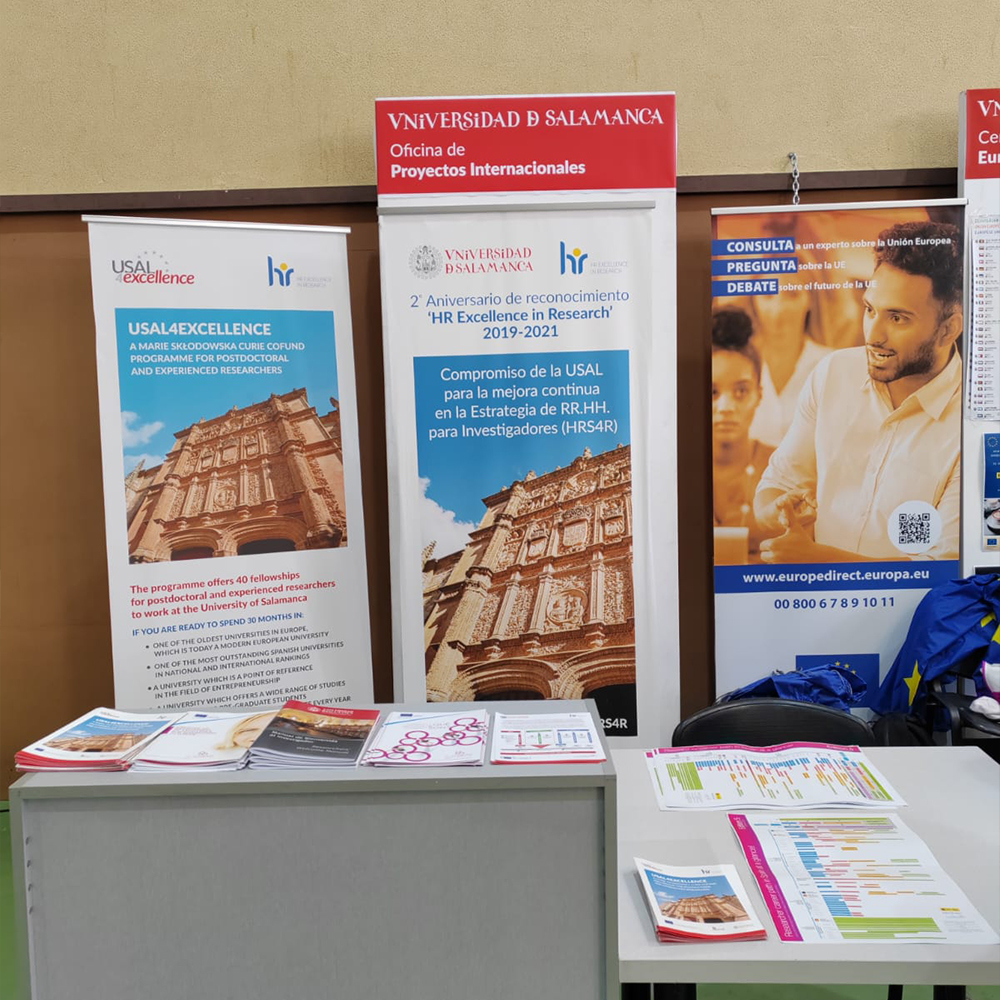
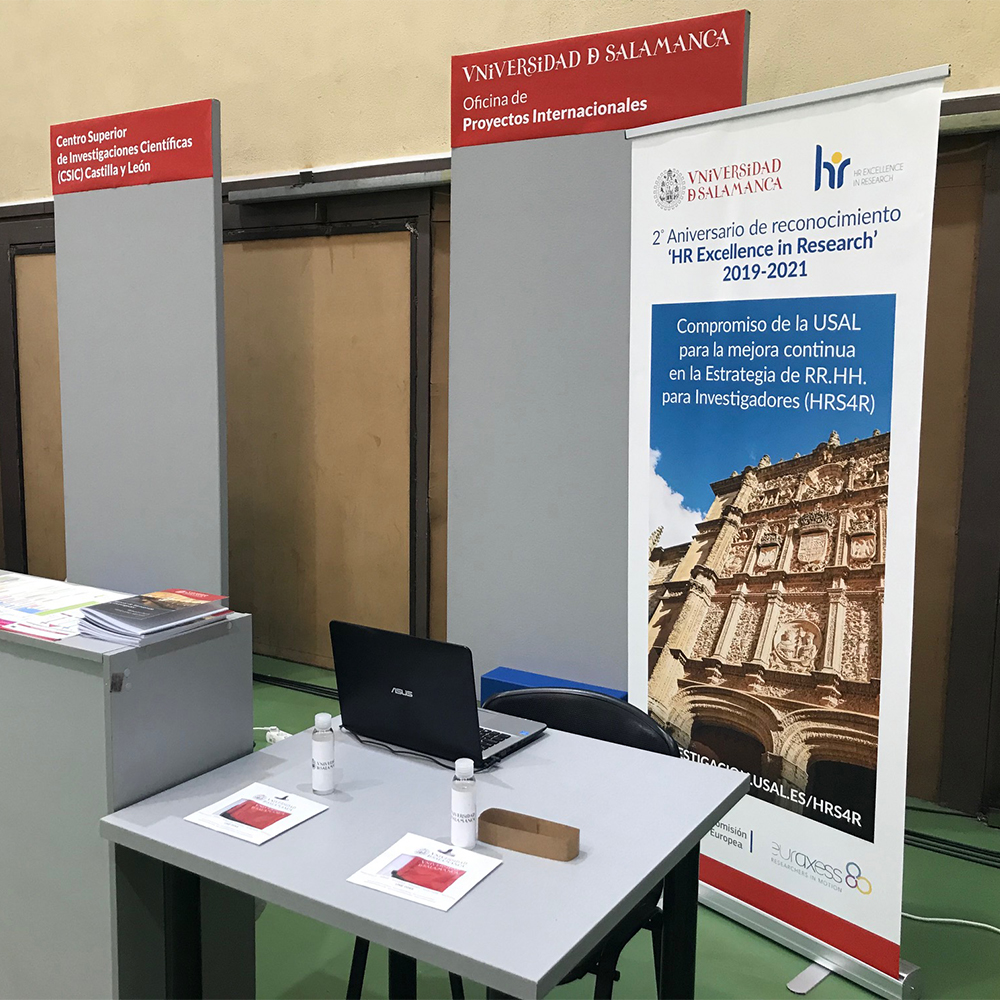
The human resources strategy of the University of Salamanca has been promoted at the welcome fairs for students and researchers in 2021, 2022, 2023 and 2024.
Action 4. Write USAL's code of good practices in research
The University of Salamanca has drawn up a Manual of Good Practices in Research. This document is intended to promote research with integrity, honesty and responsibility within the University of Salamanca. It is a complementary instrument to the current legislation, which includes rules, recommendations and commitments to promote excellence in research and the ethical behaviour of the research staff of our institution.
The following link provides access to this document:
The following informative video on Manual of Goos Practices in Research has also been produced.
Action 5. Boost the ethics/bioethics committee resources and capabilities
The Bioethics Committee changed its name to ‘Research Ethics Committee’, covering all fields of study, in March 2022. Since then, it has played a fundamental role in all USAL research projects and its role is recognised at institutional level and among the university community. The Regulations were approved at the Governing Council Session of 31 March 2022. It can be consulted at the following link:
In July 2024 the members of the Research Ethics Committee were updated on the website in order to keep the information on the Committee up to date.
In addition, the manual for the submission of research projects for assessment by the Committee has been published on the Committee’s website in English. The document ‘Guidelines on how to apply for ethical review of a research project’ is available at:
Action 6. Improve general OTM-R procedures
The University of Salamanca has continuously opted for recruitment processes that take into account merit, that are open and transparent in all phases of the different calls for applications, respecting the guarantees of applicants in terms of equality, non-discrimination or the possibility of appealing the actions, and that comply with certain standards of action. For this reason, it has implemented a series of actions aimed at improving recruitment procedures and bringing them into line with the guidelines of the Code of Conduct for the Recruitment of Researchers.
Action 7. Implement and train on OTM-R procedures
The University of Salamanca has continuously opted for recruitment processes that take into account merit, that are open and transparent at all stages of the different calls for applications, respecting the guarantees of applicants in terms of equality, non-discrimination or the possibility of appealing the actions, and that comply with certain standards of action. This is why it is necessary to have a document that embodies our OTM-R policies, whose objective is to guarantee fairness and equal opportunities during the recruitment process of researchers at the University of Salamanca.
For this reason, the ‘General guidelines for the recruitment and selection of research staff at the USAL based on OTMR criteria’ have been drawn up with the aim of serving as a guide for those responsible for the selection and recruitment procedures of researchers in the framework of projects, grants and research and knowledge transfer agreements, including all aspects that must be taken into account for a correct procedure and in accordance with the principles of the European Code of Conduct for the recruitment of researchers
OTM-R manual
The following informative video on OTMR procedures has also been produced.
Action 8. Pilot the USAL mentorship program
The University of Salamanca is committed to the creation of a career development plan for postdoctoral researchers. For this reason, in 2021 it was launched the Mentoring pilot programme: MentoR2.
The MentoR2 programme aimed to connect postdoctoral researchers with established professionals in various fields of work who can help them define the future of their professional career.
This programme has been replicated in a second edition addressed to postdoctoral researchers hired in the framework of the European project MSCA COFUND: USAL4EXCELLENCE of the University of Salamanca. A total of 39 researchers are participating in this second edition.
Action 9. Offer support for professional career development
Career development in research involves moving towards a fully independent position as researchers. Young researchers who start their profesional careers need to focus on a career development plan they want to achieve. For this reason, detailed career planning is vital to achieve professional goals.
The University of Salamanca wants to support this process and for this reason a Career Options Manual has been developed.
In addition, several courses have been organised with the aim of contributing to the development of the professional career of researchers at our University.
Action 10. Collect information concerning teleworking
At the moment, teleworking is not regulated at the University of Salamanca. However, our institution recognises that many of the tasks of a researcher do not require presence in the usual workspace for their correct performance. Consequently, support is given to professionals who decide to carry out these tasks at home or at the desired location, thereby achieving personal, family and work conciliation, as well as flexibility and reducing the carbon footprint associated with travel.
Resources
The recent needs due to the health recommendations associated with the outbreak of the Covid-19 pandemic have led to a renewal of the tools available to the USAL to enable the development of numerous tasks associated with research work. These tools include videoconferencing software and services, collaborative editing, and access to computer equipment, bibliographic resources, and editorial subscriptions through the institutional virtual private network (VPN).
You can find out more about the options available by following these links.
Action 11. Improve salaries in some special cases
The University of Salamanca has considered it of great importance to equalise the salaries of pre- and postdoctoral researchers funded by different programmes. Thus, on 20 June 2019, by means of a rectoral resolution, the University of Salamanca decided that the salaries of Juan de la Cierva Incorporación would be competitively equalised with other regional government postdoctoral contracts.
Likewise, on 16 March 2019, Royal Decree 103/2019 of 1 March 2019 was published in the BOE (Official State Gazette), approving the Statute of pre-doctoral research staff in training, with which pre-doctoral salaries (FPU, FPI and own programmes) were equalised.
Action 12. Improve assessment for researchers
The Quality Assessment Unit of the USAL carries out a biennial survey on the satisfaction of the teaching and research staff with the training programme. The most recent results can be found at:
Likewise, the University of Salamanca Library Service has organised a series of courses with the aim of training researchers in topics related to the evaluation criteria of national calls, how to improve the researcher profile, new models of scientific and academic publication, course “Sexenios de investigación 2023”: new evaluation criteria, new signs of relevance and impact, etc.
Action 13. Improve the training offer for R1 and R2
The USAL is committed to an increase in the training offer for Teaching and Research Staff. The Continuous Training Programme for Teaching and Research Staff is updated annually, based on the results of the satisfaction surveys carried out at the end of each academic year. It can be found at the following link:
There is also a section on the research portal dedicated to compiling the entire training offer aimed at researchers from the different services, units, institutes and centres:
It is worth highlighting the programme created by the Doctoral School aimed at training R1 researchers in transversal competences.
Action 14. Improve some issues concerning the supervision of R1 and R2 researchers funded by research project
The supervision agreement for R2 researcher and/or technical support staff on research tasks funded by a research project, agreement or contract has been developed and approved and will be implemented as of December 2024. This agreement includes that the hired researcher must produce a final report on the activities carried out at the end of the contract, summarising the work carried out during the entire duration of the contract, including in the event of early termination.
Action 15. Revise the gender plan
In March 2025, the Second Equality Plan of the University of Salamanca was approved for the period 2025-2029, together with a Protocol for the prevention of and action against sexual and/or gender-based harassment. Both can be consulted at: https://igualdad.usal.es/
Furthermore, the equality unit of the USAL has carried out various courses and activities throughout this period, as can be seen on its website:
REVISED ACTION PLAN
The Action Plan added four further actions:
Action 16. Monitor course interest
The University of Salamanca has implemented various initiatives aimed at improving the training needs of the teaching and research staff of this university. For this reason, different surveys have been carried out to gather the training interest of USAL staff and a series of courses have been organised in response to these interests.
Action 17. Insist on OTM-R communication (annual spreading) to strength awareness of the C&C principles
The University of Salamanca has carried out a campaign to disseminate the OTMR policy. For this reason, in June 2023, a course was organised on these policies in which aspects related to the implementation of open, transparent and merit-based recruitment criteria (OTM-R) were addressed, through specific actions that have an impact on the recruitment processes of research staff.
Within the framework of the HRS4R Logo, on 7 June, the University of Salamanca oraganized a webinar about OTM-R (open, transparent and merit-based). This webinar was about the OTM-Rprocurement criteria and the benefits of the HRS4R Logo at USAL. It addressed aspects related to the implementation of the Logo of Excellence in the USAL and how this Logo promotes the implementation of open, transparent and merit-based recruitment criteria, through specific actions that impact on the recruitment processes of research personnel. To this end, the Vice-Rector for Research, José Miguel Mateos Roco, explained the current situation of the USAL in relation to the Logo and the actions that have been carried out so far and the actions which are planned to be carried out in terms of OTM-R. Lorena Muñoz, founding partner of Effectia Innovation Consulting and European Logo evaluator, explained general aspects of the HRS4R Logo and how its implementation generates benefits not only for the institution, but also for researchers. Finally, the director of the CERCA (Centres (Research Centres of Catalonia), Lluis Rovira Pato, who is also an evaluator of the European Commission for the Logo and has extensive experience working with European organisations, addressed cases of good practices and mistakes learned for a correct implementation of the OTM-R.
Action 18. Improve the supervision skills of R3 researchers
On 10 April 2024 the USAL International Projects Office organised the course ‘Project Management for Researchers’, as part of the training programme for researchers. It was delivered online by the British company VITAE: Realising the potential of researchers and scheduled in an intensive 3-hour format. This workshop gave participating researchers the opportunity to discover tools and techniques to develop their research project management skills.
In the framework of the mentoring programme of the USAL4EXCELLENCE programme, a course on Leadership was organised to address issues related to improving the supervisory skills of researchers.
Moreover, on November 20th, 2024 the Vicerrectorate for Research organised a seminar entitled ‘Supervisory skills in research teams and their conflicts’ given by Francisco José Medina Díaz, Professor of Social and Organisational Psychology at the University of Seville. This seminar addressed the most common causes of conflicts in research teams, analysed ways to prevent them and the guidelines for dealing with them effectively. The seminar sought to provide tools to manage these dynamics and strengthen teamwork in contexts where it is necessary to collaborate and compete simultaneously. The seminar was open to all university research staff, although it was aimed primarily at R3 researchers. The seminar was attended by 65 participants, of which 23 were R3.The presentation is available here:
Action 19. Improve researchers’ work conditions with special attention to health
Each academic year, the Occupational Risk Prevention Office offers a large number of courses and workshops for researchers aimed at improving working conditions, especially in relation to the health and well-being of workers. These can be consulted at the following link:
In addition, the Welcome Manual for new employees informs new members of the Teaching and Research Staff (PDI), Technical, Management and Administration and Services Staff (PTGAS) and Research Staff and assimilated staff of their rights and obligations in terms of health and safety at work.
The Social Affairs Service also offers services of attention to diversity and inclusion, information and advice on mental and emotional health, psychological and psychiatric attention to the University Community, information and guidance on affective-sexual diversity and gender identity, mediation in changes of names in common use due to gender identity, etc. The letter of services can be consulted at the following link:

