
The HRS4R strategy is a tool launched by the European Commission to support universities, research institutions and organizations that fund research in the application of The European Charter for Researchers and The Code of Conduct for the Recruitment of Researchers, which aim to contribute to the development of an European labour market attractive for researchers.

Once an institution has made a significant progress in the ‘HR Strategy for Researchers’ process and the European Commission has acknowledged it, the institution acquires the right to use the ‘HR Excellence in Research’ logo to increase their visibility and attract the best researchers. With this widely recognised logo, a researcher can easily identify an employer committed to the principles of the ‘Charter & Code’.
The charter and the code of conduct are recommendations made by the Commission to Member States, which are invited to apply them voluntarily:
THE CHART
The European Charter for Researchers is a set of general principles and requirements which specifies the roles, responsibilities, and entitlements of researchers as well as of employers and/or funders of researchers. It constitutes a framework for researchers, employers and funders which invites them to act responsibly and as professionals within their working environment, and to recognise each other as such.
THE CODE
The Code of Conduct for the Recruitment of Researchers consists of a set of general principles and requirements that should be followed by employers and/or funders when appointing or recruiting researchers. These principles and requirements are complementary to those outlined in the European Charter for Researchers. Institutions and employers adhering to the Code of Conduct will openly demonstrate their commitment to act in a responsible and respectable way and to provide fair framework conditions to researchers, with a clear intention to contribute to the advancement of the European Research Area.
BENEFITS
The ‘Human Resources Strategy for Researchers’ or HRS4R supports research institutions and funding organisations in applying the Charter and Code (C&C) in their policies and practices. The application of the principles of the Researcher Charter and the Code of Conduct for the Recruitment of Researchers by research institutions makes them more attractive to researchers looking for a new employer or a host for their research project. That is why the University of Salamanca has applied for, achieved and intends to secure, through a continuous effort in its human resources related actions, the HR Excellence in Research Award.

Benefits for the University of Salamanca
- International visibility: the University of Salamanca belongs to the group of more than 700 European research organisations with the HR label.
- Credibility and transparency: by publishing the strategy, its actions and the OTM-R policy, the University of Salamanca reinforces its credibility and contributes to the transparency of recruitment policies and processes.
- Attraction of talent: researchers who are considering different employment alternatives will be able to know that the University of Salamanca is concerned about the working conditions of its researchers and will be able to access the human resources policies of the institution.
- Positive assessment in R&D projects: obtaining the HR seal provides project management offices with a very important tool for the management and justification of projects in which human resources policies are fundamental.

Benefits for Researchers
- Improved working environment: implementation of HRS4R leads to a better working environment for researchers, with policies and practices that promote wellbeing, equality and professional development.
- International recognition: HRS4R certification is recognised internationally as a standard of quality in human resource management in research, which can enhance the reputation and credibility of the institution and, by extension, the researchers working there.
- Career development: institutions with the HRS4R seal of approval offer strong career development programmes, including training, mentoring and mobility opportunities, which benefit researchers in their career progress.
- Work-life balance: the implementation of work-life balance policies helps researchers achieve a better work-life balance, which contributes to their well-being and job satisfaction.
Use of the HR label in projects
Recognition of the HRS4R can be positively valued when applying for European and national projects, especially those funded by the European Union (EU) through programmes such as Horizon Europe.
EU-funded research and development (R&D) projects
Horizon Europe, the EU’s funding programme for research and innovation, is a key example. Within Horizon Europe, specific programmes such as Marie Skłodowska-Curie Actions (MSCA) aimed at supporting the training and professional development of research staff through postdoctoral projects (MSCA-Postdoctoral Fellowship), doctoral networks (MSCA-Doctoral Network) or research staff exchange (MSCA-Staff Exchange) may positively consider HRS4R certification when evaluating proposals. In this type of project, the institutions’ commitment to good practice in human resources management is highly valued.
International Collaboration Projects
Projects involving collaboration with institutions in other European or international countries may consider HRS4R certification as an indicator of the quality of the research environment and institutional commitment to excellence in human resource management.
EU Research Projects in other fields
In addition to Horizon Europe, the EU funds projects in a variety of areas, such as health, environment, energy, education and culture. While these projects may not be directly related to scientific research, they can still assess the institutions’ commitment to best practice in human resource management.
Spanish government research funding programmes
Agencies such as the Agencia Estatal de Investigación or the Instituto de Salud Carlos III offer funding for research projects in various areas. These entities can positively value HRS4R certification as an indicator of the institutions’ commitment to best practices in human resources management in research.
Regional research and development initiatives
At the regional level, development agencies and local authorities may value HRS4R certification as part of initiatives to promote research and knowledge-based economic development in their regions.
STAGES OF THE PROCESS AT USAL
With the objective to adjust the research institutions practices to the principles established in the ‘Charter & Code’, the European Commission set a procedure through which the interested institutions could design their own Human Resources (HR) Strategy for Researchers.
This process is composed of five steps, distributed along three phases, as it can be seen in the image:
The research institution carries out an Internal Analysis (usually consisting of a GAP analysis), with the objective of checking the aligning of the internal institution Human Resources policies to the 40 principles stated in the ‘Charter & Code’ in the four areas (Ethical and Professional aspects, Recruitment and Selection, Working and Social Conditions, and Training and Development).
The research institution publishes Human Resources Strategy for Researchers in a section of their website, which must be accessible and in English. Therein, the results of the Internal Analysis must be presented. In the same way, a detailed Action Plan must be published in the website, containing the measures that the institution will adopt in order to make up for the encountered gaps, in order to achieve a better alignment with the principles and requirements of the ‘Charter & Code’.
The Internal Analysis and the Action Plan are evaluated by external independent experts. In the case that the evaluation is positive, the European Commission acknowledges that the research institution adopted the Human Resources Strategy for Researchers, by giving it the HR award for the first time.
The research institution develops its Human Resources Strategy for Researchers by executing the Action Plan. After two years, a self-evaluation 24 months after the HR award by means of its own mechanisms that ensure quality is carried out.
Five after following the concession of the HR award, and with a periodicity of 36 months, the institution progress in the pursue of the objectives of its Human Resources Strategy for Researchers, and its conformity with the principles and requisites of the ‘Charter & Code’ are subjected to external evaluation. With each periodic evaluation, the HR award is renewed.
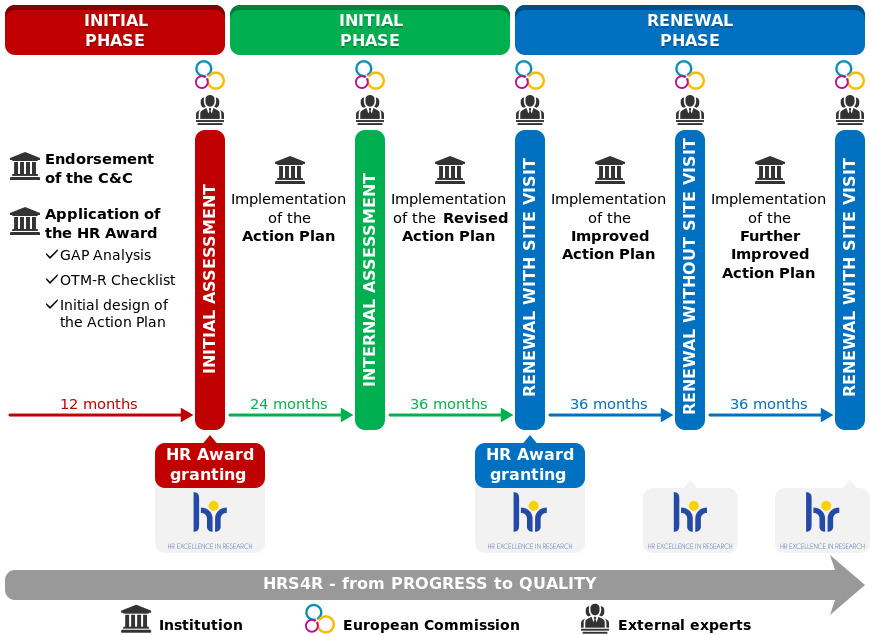
Procedure to get the ‘HR Excellence in Research’ acknowledgement by means of a progress towards excellence in the Human Resources Strategy for Researchers (HRS4R).
Initial phase
In July 2018, the University of Salamanca signed and sent to the European Commission, its Endorsement Letter to the European Charter for Researchers and the Code of Conduct for the Recruitment of Researchers, stating its will to adhere to these values and principles, ant its commitment to implementing a Human Resources Strategy for Researchers in agreement with them.
Along the course 2018-2019, USAL established an interdisciplinary committee, which involves the governing organisms of the institution, the management services, and researchers –permanent and temporary– from all the areas of knowledge, with the purpose of carrying out the Internal Analysis, starting up this way the initial phase of the Human Resources Strategy.
Such Analysis consisted on a GAP Analysis, that allowed to identify both the areas in which the internal policies of USAL in good alignment with the principles and requisites laid down in the ‘Charter & Code’, as well as those where improvements should be made to meet such requirements. Also, some measures to make up for the deficiencies found and to be applied along the successive years in order to progress and improve such areas were proposed. These measures are collected in the Action Plan.
Implementation phase
After the positive Initial Evaluation, the 23th of July 2019, the University of Salamanca obtained from the European Commission the ‘HR Excellence in Research’ award.
During the subsequent 24 months, the University of Salamanca has been working on the fifteen actions designed to improve the institution’s human resources policies, starting with those of greatest urgency for the university community, such as updating the Research Portal, the publication of various manuals and the dissemination of the characteristics and advantages of the new measures implemented, of which you can learn more of in the Action Plan.
Thanks to our efforts, the European Commission favorably evaluated the University of Salamanca after its Internal Evaluation, in July 2021, crystallizing in the Revised Action Plan, with recommendations for the execution of the actions of the original Action Plan, and the creation of four other new measures aimed to improve working conditions and the training offer for research staff.
Currently, USAL is working on the Revised Action Plan for the close renewal of the award, in July 2024, which will include the visit of the European Commission and the preparation of a new Improved Action Plan.

